I still remember the moment I first saw Kasbah Telouet rising from the rust-colored earth of the Ounila Valley. The air was thin at 1,800 meters, sharp with mountain cold, and the fortress looked like it was melting back into the landscape. While thousands of visitors crowd into Aït Ben Haddou each day, cameras ready for that perfect Game of Thrones backdrop, this equally magnificent palace fortress stands nearly empty. Crumbling, yes. But haunting in its beauty.
This is the forgotten side of Morocco’s history. The side that doesn’t make it onto every Morocco itinerary, but absolutely should.
When you travel Morocco beyond the usual circuit of Marrakech, Fes, and Chefchaouen, you discover places like Telouet. Places where history isn’t polished for tourists. Where you can walk through corridors of a feudal palace without battling selfie sticks, where the silence itself tells stories.
What Makes Kasbah Telouet Important to Morocco Travel?
Kasbah Telouet was the seat of power for the Glaoui family, known as the “Lords of the Atlas.” Located in the High Atlas Mountains between Marrakech and the Sahara Desert, this wasn’t just a fortress. It was the control center for one of Morocco’s most powerful dynasties.
The Glaoui family grew extraordinarily wealthy by controlling vital trade routes connecting northern Moroccan cities to the desert. Every caravan carrying salt, gold, spices, and slaves passed through their territory. Every merchant paid their taxes.
Thami el Glaoui, the last and most notorious of these mountain lords, became Pasha of Marrakech in the early 20th century. His strategic alliance with French colonial authorities made him one of the most powerful men in Morocco. His ambition transformed this mountain outpost into an extravagant palace that rivaled the grandeur of any royal residence.
But power built on colonial collaboration doesn’t last. When Morocco gained independence in 1956, the Glaoui family fell from grace overnight. Their mountain stronghold was abandoned, left to the wind and rain and time.
What remains is a monument to ambition, betrayal, and the impermanence of power. [INTERNAL_LINK: Exploring Morocco’s imperial cities and their forgotten stories -> Morocco’s Hidden Historical Sites]
The Architecture: Where Berber Tradition Meets Moorish Splendor
From outside, Kasbah Telouet looks like a red ruined hulk. Its pisé walls (mud brick mixed with straw and stone) are weathered, cracked, entire sections collapsed. The harsh Atlas Mountain climate shows no mercy to earthen architecture.
Step inside, though, and the transformation is startling.
The kasbah showcases a fascinating architectural fusion. Traditional Amazigh (Berber) fortress design meets Hispano-Moorish palace aesthetics. Painted cedarwood carved into geometric impossibilities. Intricate plaster work (gypsum carved so delicately it looks like lace) framing doorways and windows. Bright zellij mosaics covering walls in patterns that make your eyes dance.
Unlike Aït Ben Haddou, which functioned as a fortified village (ksar) housing many families, Telouet was a true kasbah. A personal fortress-palace for the ruling family. This distinction matters when you visit Morocco and explore these sites. A ksar feels communal, lived-in by ordinary people. A kasbah feels intimate and aristocratic, designed to display power.
The kasbah contained private family quarters, reception halls for political dealings, administrative offices, storage rooms, and even a hammam. Everything the Glaoui family needed to rule their mountain empire without descending to the cities below.
How to Experience the Interior Rooms
The preserved sections of Kasbah Telouet center on two magnificent Andalusian-style reception rooms. These spaces would have hosted visiting dignitaries, French colonial officials, and tribal leaders seeking the Pasha’s favor.
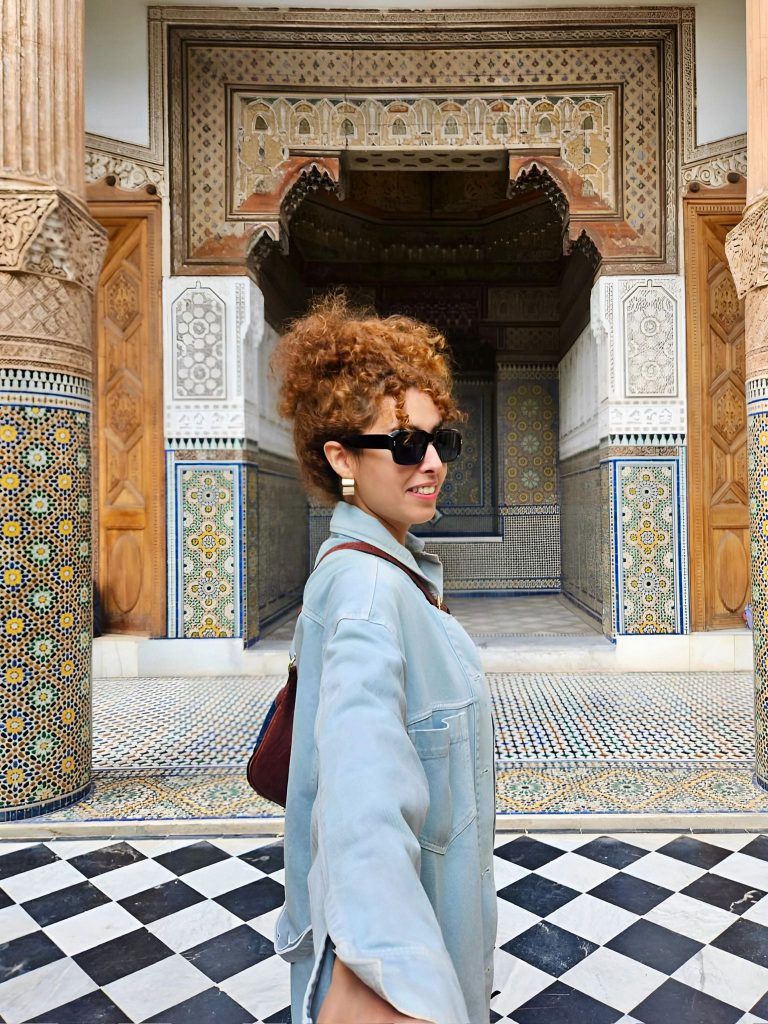
The walls explode with color. Zellij tilework in deep blues, forest greens, burnt oranges, and golden yellows climb from floor to shoulder height. Above that, carved stuccowork in intricate geometric and floral patterns. The ceilings are painted cedarwood, each panel a work of art.
Look closely at the zellij and you’ll spot something unexpected: tiles decorated with the Star of David. This detail hints at the multicultural influences shaping Morocco’s design traditions, the Jewish artisans whose craftsmanship graced even Muslim palaces. [INTERNAL_LINK: The Jewish heritage of Moroccan craftsmanship -> Morocco’s Artisan Heritage]
The windows are framed with elegant iron grills, each one unique. Through them, you see the Ounila Valley spreading below, the peaks of the High Atlas rising beyond. Even in decay, even half-ruined, the views alone justify the journey.
Climb to the roof (carefully, some sections are unstable) and the true scale reveals itself. Kasbah Telouet was enormous. An entire complex of fortress, palace, and caravanserai spreading across the mountainside. Most of it is rubble now, but your imagination can fill in the rest.
When Is the Best Time to Visit Morocco’s Mountain Kasbahs?
The best time to visit Morocco’s Atlas Mountain region, including Kasbah Telouet, is spring (March to May) or autumn (September to November). During these seasons, temperatures are mild, the mountain passes are clear, and the light is extraordinary.
I visited in late April, when wildflowers dotted the valley and snowmelt swelled the rivers. The air was crisp but not cold, perfect for exploring without the summer heat that can make these earthen structures feel like ovens.
Winter (December to February) brings snow to the high passes, which can make the drive challenging or impossible. Summer (June to August) brings intense heat to the valleys, though the mountains remain cooler than cities like Marrakech.
The kasbah itself is rarely crowded any time of year. This is still one of Morocco’s overlooked treasures.
Planning Your Morocco Itinerary: Getting to Telouet
Kasbah Telouet sits about 100 kilometers southeast of Marrakech, a two-hour drive through increasingly dramatic landscape. Most visitors combine it with a trip to Aït Ben Haddou, creating a loop that showcases both the famous and the forgotten.
The journey itself is part of the experience. The road climbs through the Tizi n’Tichka pass (2,260 meters), one of the highest mountain passes in North Africa. Hairpin turns reveal valleys that shift from green to ochre to deep red. Small Berber villages cling to hillsides, their homes the same earth-toned pisé as the ancient kasbahs.
You can visit Telouet as a day trip from Marrakech, but I recommend building it into a longer Morocco travel itinerary. Spend a night in the valley. Stay in a traditional guesthouse in nearby Aït Ben Haddou or the town of Telouet itself. Experience the mountains when tour buses have left and locals reclaim their rhythms.
The drive from Telouet to Aït Ben Haddou follows the old caravan route through the Ounila Valley. This unpaved track (passable with careful driving) passes through abandoned kasbahs, crumbling granaries, and villages where time moves differently. It’s rough, dusty, and absolutely worth it for adventurous travelers. [INTERNAL_LINK: Planning your High Atlas mountain road trip -> Morocco Road Trip Itineraries]
What You Need to Know Before You Visit
Kasbah Telouet is not a polished tourist attraction. There’s a small entrance fee (usually around 20-30 dirhams), collected by local guardians who maintain the site and offer informal tours.
Accept the tour. These guardians know stories the walls can’t tell. They’ll point out details you’d miss, explain the function of mysterious rooms, share family histories passed down through generations. Tip generously. Morocco tourism in places like this depends on local knowledge keepers.
Wear sturdy shoes. Floors are uneven, some staircases are crumbling, and you’ll be climbing over rubble to reach the best viewpoints. Bring a flashlight or use your phone’s light. Some interior corridors are dark, electricity nonexistent.
The kasbah has no facilities. No bathrooms, no cafe, no gift shop. Come prepared with water and snacks. The nearest restaurants are back in the village.
Photography is allowed and encouraged. The play of light through broken ceilings, the patterns of decay, the contrast between ruin and surviving beauty create endless compositions.
Why Telouet Matters in Your Morocco Travel Story
Standing in those painted rooms, surrounded by beauty that no one bothered to destroy or preserve, I understood something about Morocco that polished tourist sites can’t teach.
This country contains multitudes. Glory and ruin existing side by side. Collaboration and resistance. Preservation and neglect. The Morocco travel guide books show you monuments restored and protected. Telouet shows you what happens when power shifts and history moves on.
The Glaoui family backed the wrong side. Their mountain empire crumbled as fast as it rose. But the artisans who carved those ceilings, laid those tiles, shaped that plasterwork, they created something that outlasted political allegiance. Beauty persists even when power doesn’t.
That’s the lesson Kasbah Telouet offers. That’s why it deserves a place in every thoughtful Morocco itinerary, alongside the imperial cities and desert dunes and coastal medinas.
When you visit Morocco, seek out the forgotten places. They tell truer stories than the famous ones.